Humans take eighteen years to grow up. What a country teaches its children in those years decides everything that follows. That is my argument.
Education is not just important. It is the root. Once a people is educated, they live longer, have fewer children, make better health choices, and pass all of this on to their own children. They do not need to get rich first, and they do not need the state to do it for them.
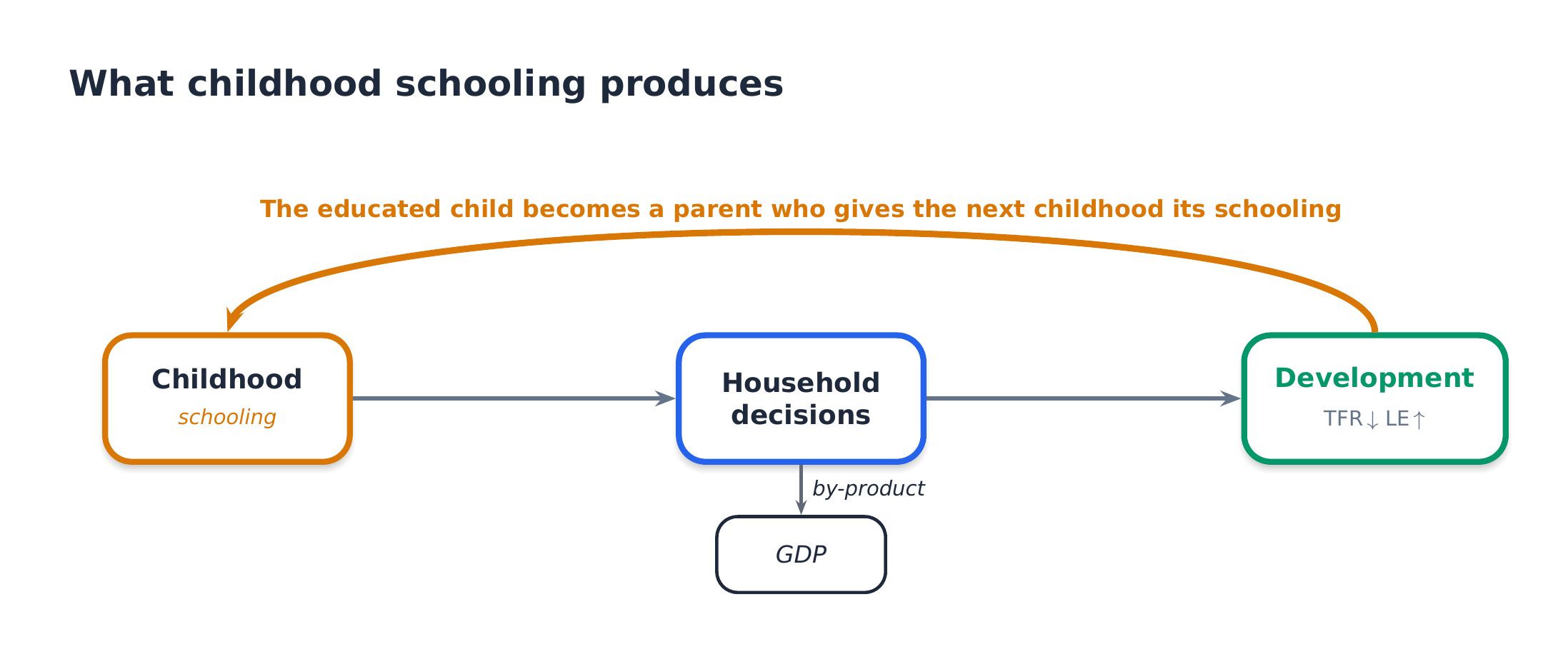
Here is how it works. A child learns from the people closest to her: her parents, her grandparents, her older siblings. If they went to school, they pass on what they know, and they make one choice that matters most of all: they send her to school too. The state cannot make this happen by force. Its job is to build the schools and pay the teachers until enough families carry it forward on their own. Each educated generation raises the next. The wheel only turns one way. It never slips back.
I measure development plainly: people living past 69.8 years, and women having fewer than 3.65 children. Those were the United States numbers in 1960. The UN’s Human Development Index counts education as part of development itself, not just a road to it. I agree — and I measure by what it delivers. By 2022, 154 countries, holding 80% of all people on earth, had passed that mark. Every single one did it through education. The only difference was how fast.
You can test this, so I did. Take a country’s wealth and strip out the part that education created. Use what is left to guess how long its people live and how many children they have. Across 144 countries and 140 years of data, that leftover wealth predicts almost nothing: under 2% of any outcome, and exactly nothing for how many children women have. Education alone predicts about half. Its pull reaches across four generations. Wealth fades out in one. Money looked like it mattered only because education was moving through it.
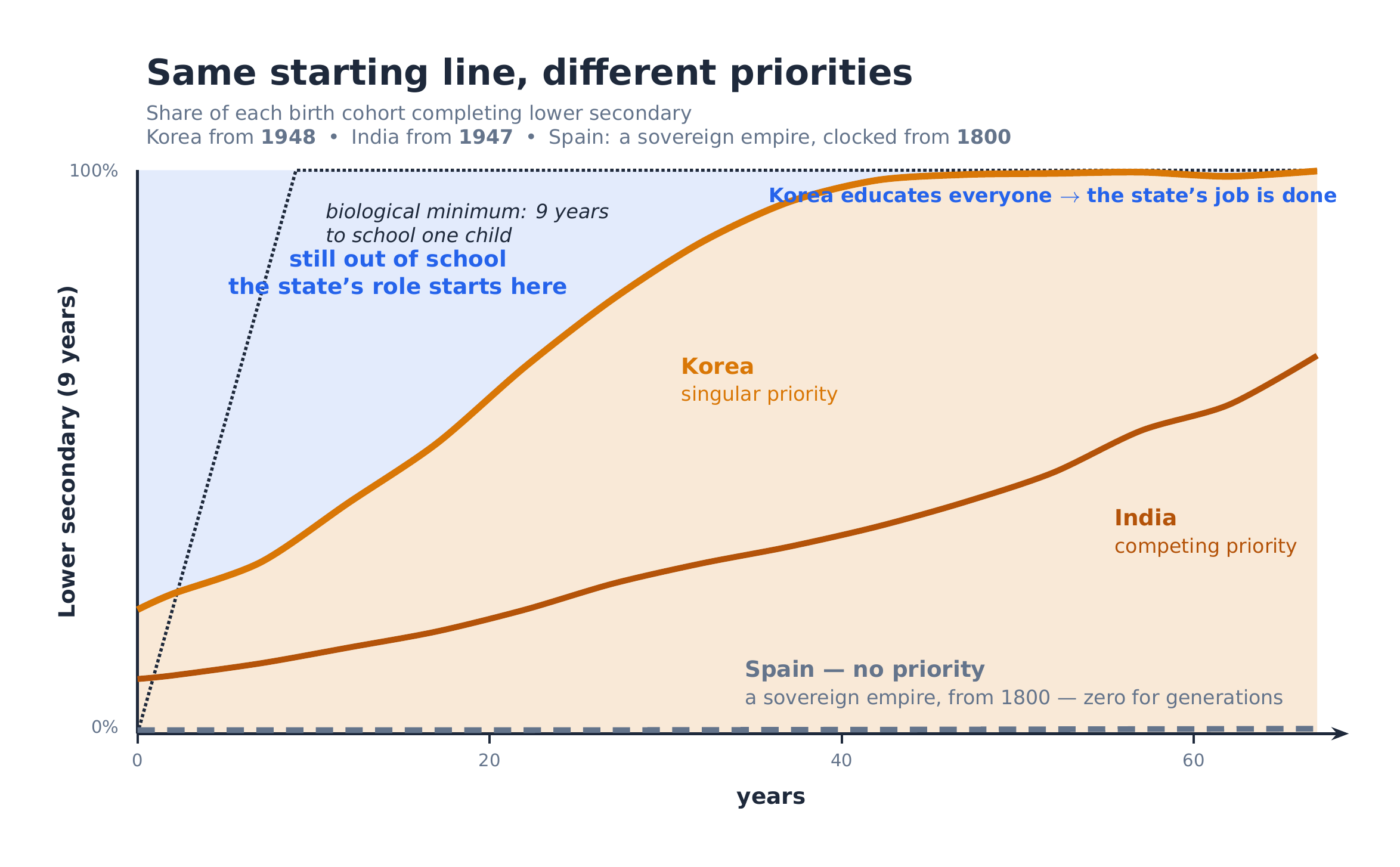
History says the same thing. Spain was the richest empire on earth for two hundred years, and it took 450 years to develop, because money was never the engine. Korea was one of the poorest countries in the world in 1953. It made education its single highest priority, above everything else, and it crossed the line in 35 years. Bangladesh crossed it while still poor. So did Nepal. None of them waited to get rich. And of the 21 great famines since 1950, 19 hit places where fewer than half of young adults had finished basic school. Educated people do not starve.
The last fifth of humanity, most of it in sub-Saharan Africa, is not waiting for money or aid. It is waiting for one decision: to put schooling, and girls’ schooling above all, first and keep it there. School numbers rise within five to ten years. The full payoff in lives comes one generation later, and it cannot be undone, because it lives in people, not in budgets.
The children who will carry the next leap are in school right now. Those years hold only what we put into them, and they close one class at a time. And the decision is not even a new one. In 2015 every government on earth signed it — Sustainable Development Goal 4: ensure that all girls and boys complete free, equitable and quality primary and secondary education by 2030. The decision is not to ask for more than was promised. It is to keep the promise.
Want the longer version? Read the essay for the policy argument, or the full paper for the methods and evidence.